
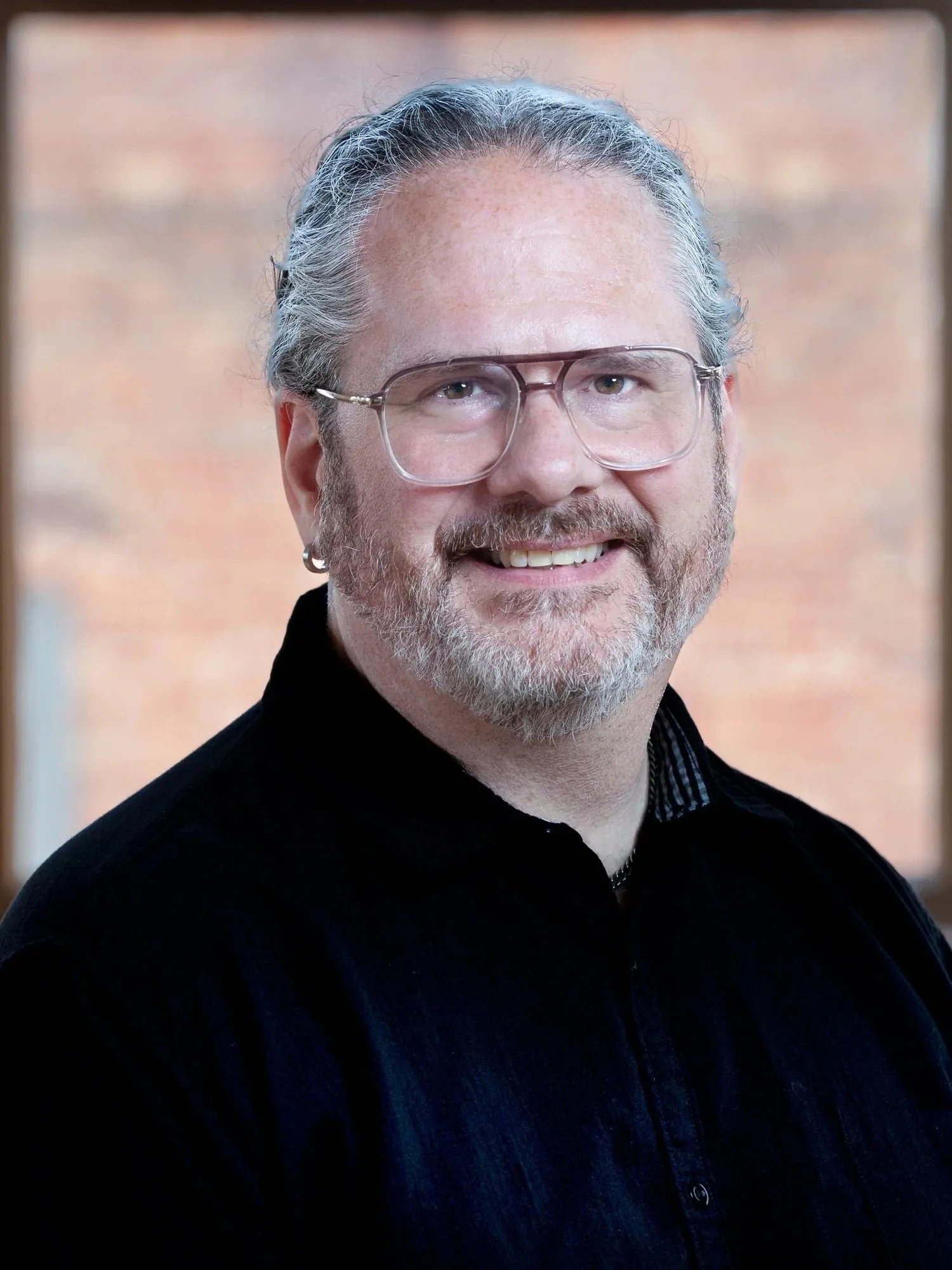
Follow Mike on YouTube, TikTok, Instagram:
About Mike
Here's the short version of who I am and why this work exists. The longer story is below.
I'm a writer and musician based in central Wisconsin. I wrote a book called From Reactive to Resilient about how to stay steady when life pulls the floor out from under you.
I do that work because I had to learn how to do it myself — and what I found along the way seemed worth passing on.
If you're here because something just changed — a marriage, a job, a faith you used to hold, a sense of who you thought you were — that's the audience this was made for. I've been there. I'm still there sometimes. And I've found a way of working with it that actually helps.
When Identity Feels Lost
In 2008, I was fired from a full-time ministry position I'd held for about a decade. I picked up volunteer work at a different church and tried to rebuild from there.
Six years later, in 2014, my 25-year marriage ended — and when the leadership at the second church found out about the divorce, they let us go from those roles too.
Two waves of the same kind of loss, six years apart. I won't get into all of it here. But the part that mattered most wasn't losing the jobs or the marriage. It was losing my sense of who I was without them.
When your identity is built around external roles — your title, your relationships, the community you belong to, the beliefs that used to organize everything — losing those feels like losing everything.
There's a particular kind of disorientation that comes with it. You don't just have to figure out what to do next. You have to figure out who's doing the figuring.
I want to say something specific about faith transition, because it doesn't always get named on its own. Losing a belief framework — or a community built around one — is its own category of identity loss. It's not quite like losing a job or a marriage, though it can happen alongside either of those. It's losing the lens through which everything else made sense. If that's where you are, I understand that particular kind of disorientation pretty well. And I'd say there's a way through it that doesn't require replacing one framework with another.
Maybe you're there right now. Career ended. Marriage fell apart. Beliefs you used to hold don't hold anymore. The question that comes up — who am I without all of that — can be paralyzing. There's a way through it that doesn't require having everything figured out first.
What I Found
The thing that eventually helped me wasn't a new belief system or a particular practice borrowed from someone else's tradition. It was a distinction I'd been missing — the difference between my temporary circumstances and the steadier awareness underneath them.
That sounds abstract written down. In practice, it just meant I stopped trying to rebuild a fixed identity from the wreckage and started working with what was actually still there: the capacity to notice, to allow, to choose a response.
From that, over a few years, I worked out a four-step framework I now call the C.A.L.M. Method:
C — Connect with what's happening in and around you. A — Allow the things that are to be as they are. L — Let Go of your running commentary about the situation. M — Move Forward with action informed by the present moment.
It's not theory I read about and decided to teach. It's what I had to figure out to keep going. I've since walked through it with a lot of other people working through divorce, job loss, midlife transitions, and belief change — and it tends to do the work it says it does.
The Book
From Reactive to Resilient: Practical Awareness for Major Life Changes is where the full method lives. Fifteen chapters, plus a 30-day action plan, applying C.A.L.M. across the kinds of situations where most of us actually get stuck — relationships, identity disruption, anxiety, grief, conflict, faith change.
I wrote it for people in the middle of a hard transition. But honestly, the practices work whether you're in one or not. They're easier to learn before the next hard thing shows up than after.
What's Behind the Work
I'm not a licensed therapist or a psychology researcher, and I want to be upfront about that. What I am is someone who lived through identity collapse and rebuilt from it — and who took the framework that helped me and tested it against the research that's already out there.
The book has 184 endnotes. It went through professional editing with Cathy Suter, who has worked on books by Jon Kabat-Zinn. I mention that not as a credential transfer, but because it gave me confidence the content meets the standards I'd want it to meet for a reader trusting me with this kind of material.
I'll add this: the posture of the work — the way it doesn't claim authority it doesn't have, the way it invites rather than instructs — reflects how I needed this material to come to me when I needed it most. I'd been inside enough systems that spoke with more certainty than they'd earned. So I tried to write something that wouldn't do that.
Outside of the book, my life looks pretty ordinary. I live in central Wisconsin. I work full-time at a software company. I play keyboard in a band called Boogie and the Yo-Yos and have released several instrumental albums on my own and under the name "i minus i."
The writing and the music are connected for me — they're both ways of helping someone find some ground when the day's been rough.
What This Isn't
A lot of self-help work tells you to "find yourself" or "discover your purpose." That advice has a place, I guess. But during actual identity crisis, it's pretty hard to do. You can't think your way out of not knowing who you are.
C.A.L.M. starts somewhere different. It's not asking you to find anything. It's asking you to notice what's already here, allow it to be what it is, let go of the running argument with it, and move forward from there.
No new beliefs required. No particular spiritual tradition — and I mean that from experience, not just as a positioning statement. Just the capacity to pay attention, which everyone already has. That's the whole posture of this work. It doesn't promise to fix you. It assumes you don't need fixing — that what you need is a steadier place to stand.
Where to Start
If you're new here, the easiest entry point is the free guided audio download. It walks through the C.A.L.M. Method, includes a self-assessment, and gives you a few practices you can try this week.
Download the Guided C.A.L.M. Method Audio →
If you'd rather go deeper:
Read the articles — practical writing on identity, transitions, and present-moment work.
Get the book — the full framework, in sequence, with practices for fourteen chapters of common stuck-points.
Subscribe on YouTube — weekly videos walking through C.A.L.M. one chapter at a time.